


What robotic knee replacement is
In a knee replacement, the worn ends of the bones are shaped to receive the implant. How accurately those bone cuts are made affects alignment, balance and how the new knee feels. In conventional surgery, the surgeon makes these cuts by hand using mechanical guides.
In robotic knee replacement, the operation is planned in advance on a 3D model of your knee built from a CT scan. During surgery, a robotic arm prepares the bone to that plan, while the surgeon supervises, checks and adjusts each step. Dr. Chandrashekar trained in robotic knee replacement in Seoul, and has operated with the CUVIS Joint system since its launch in Bengaluru in 2020.
The CUVIS Joint system
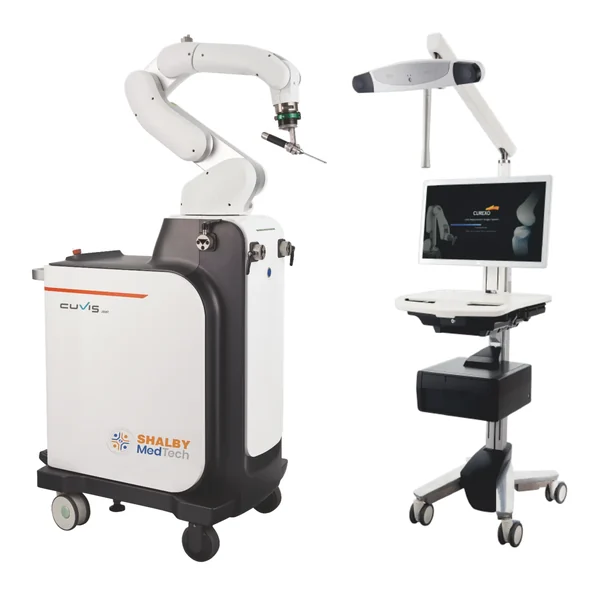
CUVIS Joint is a CT-based active robotic system. It is designed around four principles:
- SimplicityA 3D bone model is generated from CT images, and the interface shortens preparation time.
- AccuracyThe pre-surgical plan is carried out as approved, with sub-millimetre dimensional accuracy according to the manufacturer.
- FlexibilitySeveral cutting options, and the plan can be changed during surgery to balance the knee.
- SafetyReal-time monitoring, an emergency stop and force freeze, with the option of guiding the arm manually.
Robotic knee replacement, step by step
- Consultation: examination, X-rays and a discussion of all options, including whether robotic surgery adds value for you.
- CT scan: images of the leg are used to build a 3D model of your knee.
- Planning: Dr. Chandrashekar sizes and positions the implant on the model and simulates the result.
- Surgery: the knee is exposed and registered to the plan. The robotic arm prepares the bone under the surgeon's control, and the implant is fitted and balanced.
- Recovery: physiotherapy begins early, followed by a structured programme and follow-up visits.
Types of surgical robot
Not all robotic systems work the same way. Broadly, they fall into three groups:
- Passive systems are navigation tools, usually imageless or X-ray based. They guide alignment but do not prepare the bone.
- Semi-active systems use CT images and a robotic arm that the surgeon moves by hand within set boundaries.
- Active systems, such as CUVIS Joint, use CT-based planning and a robotic arm that performs the planned bone cuts in the sequence the surgeon chooses, under his supervision and control.
Who may be suitable for robotic surgery
Robotic knee replacement may be considered for people with advanced knee arthritis who need a replacement, including some with deformity. Suitability depends on the pattern of damage, bone quality, previous surgery, any metal implants near the knee, and your general health. It is assessed individually.
What about the hip?
This page describes robotic knee replacement. Whether robotic or computer-assisted techniques are appropriate for your hip replacement is discussed at consultation. About hip replacement
Limitations of robotic surgery
- A CT scan is needed, which adds a small radiation dose and a planning step.
- Precision in bone preparation does not remove the usual risks of knee replacement, such as infection, clots or stiffness.
- Recovery still depends on rehabilitation and your overall health.
- It usually costs more than conventional surgery.
Questions about robotic surgery
Robotic assistance helps carry out a detailed plan with high precision, which supports accurate implant positioning and alignment. Long-term outcomes also depend on the surgeon, the implant, your health and rehabilitation. Dr. Chandrashekar will explain whether it offers a meaningful advantage in your case.
No. The surgeon plans the operation, approves every step and supervises throughout. The system prepares the bone only within the approved plan and boundaries, and it can be stopped, adjusted or switched to manual guidance at any time.
The cost depends on whether one or both knees are treated, the implant chosen, the length of hospital stay and your insurance cover. After the consultation and scans, the IKOC team gives you an itemised written estimate, so you can compare it with other options before deciding.
Yes. A CT scan of the leg is needed before surgery so that a 3D model of your knee can be created for planning.
Robotic surgery usually costs more than conventional surgery because of the scan, planning and technology involved. The IKOC team can give you an estimate based on your procedure and insurance after the consultation.
Rehabilitation follows the same principles as conventional knee replacement: early walking, daily exercises and gradual return to activity. How quickly you progress depends on your health, the procedure and physiotherapy.
Talk it through with Dr. Chandrashekar
A consultation is where every option is weighed, including whether surgery is needed at all.